500 kW Solar Plant Cost in Gujarat: Investment, Generation & ROI
500 kW Solar Plant Cost in Gujarat: Investment, Generation & ROI
For factories, manufacturing units, warehouses and large commercial facilities in Gujarat, a 500 kW solar plant can be an effective way to reduce dependence on grid electricity and manage long-term energy costs. However, the right investment decision requires more than knowing the installation price.
Before investing, businesses should evaluate the 500 kW solar plant cost, expected electricity generation, annual savings, ROI, payback period, available roof or land area, system design and EPC scope.
This guide explains the key factors businesses should consider when evaluating a 500 kW solar project in Gujarat.
What Is a 500 kW Solar Plant?
A 500 kW solar plant is a photovoltaic (PV) power generation system designed to deliver up to 500 kilowatts of installed DC capacity, depending on the system configuration and equipment selected.
It can be designed for different applications, including:
- Industrial factories
- Manufacturing facilities
- Warehouses and logistics centres
- Commercial buildings
- Educational institutions
- Hospitals and healthcare facilities
- Large business premises
For businesses with substantial daytime electricity consumption, a 500 kW system can help generate power closer to the point of consumption, potentially reducing the amount of electricity purchased from the grid.
The most suitable configuration—such as Rooftop, Ground-Mounted, Captive or another project structure—depends on the site’s electricity consumption, available space, regulatory requirements and project objectives.
500 kW Solar Plant Cost in Gujarat
The cost of a 500 kW solar plant in Gujarat does not have one fixed price for every project.
The final investment depends on several factors, including:
- Solar module technology and brand
- Inverter capacity and configuration
- Mounting structure
- Rooftop or ground-mounted installation
- Roof condition and structural requirements
- DC and AC electrical infrastructure
- Cabling and protection systems
- Civil and installation work
- Grid connectivity requirements
- Project engineering and commissioning
- Monitoring and safety systems
- Site accessibility and installation complexity
Therefore, businesses should be careful with online estimates that provide one fixed price for every 500 kW solar project.
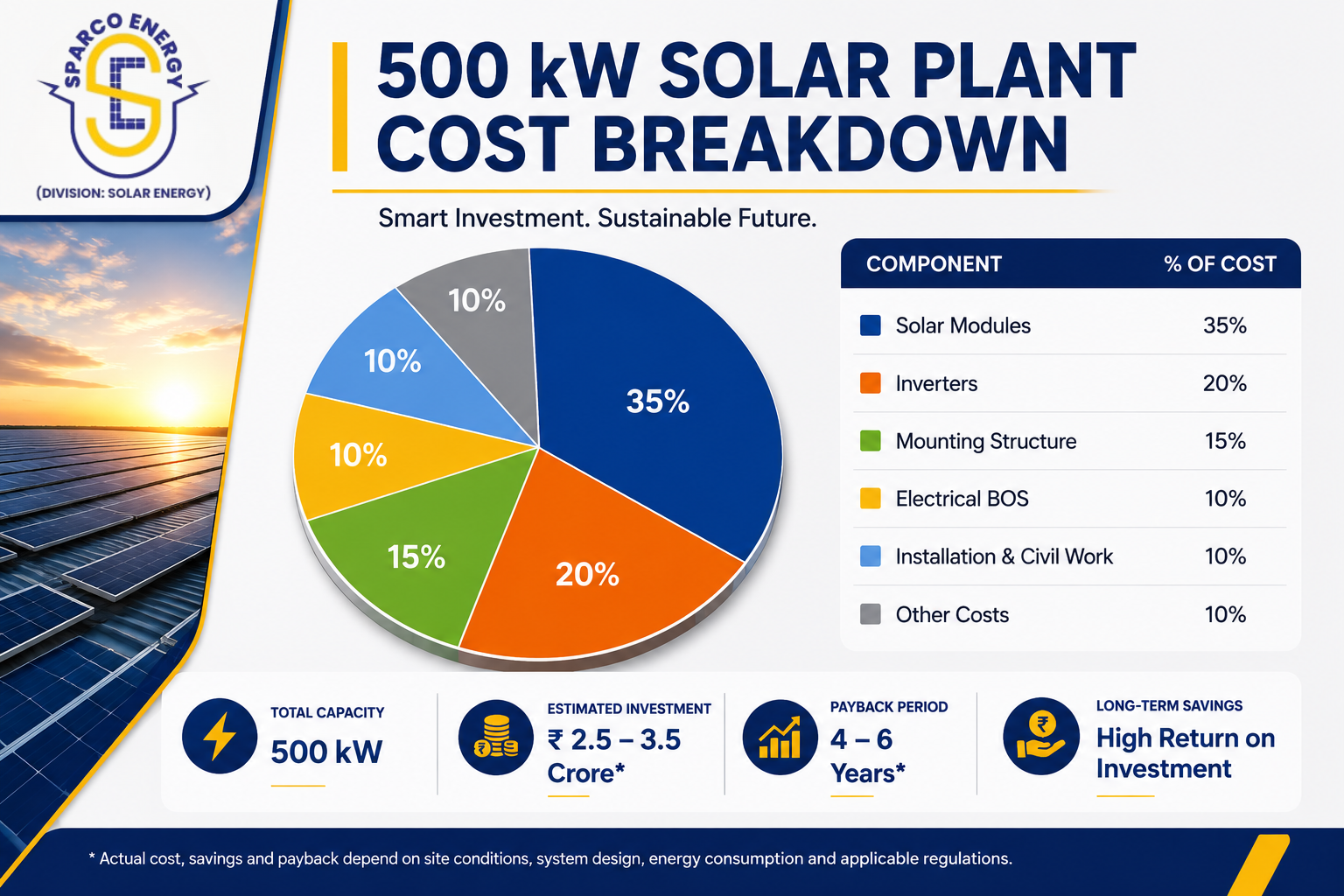
Indicative 500 kW Solar Plant Cost Components
| COST COMPONENT | WHAT IT COVERS |
|---|---|
| Solar Modules | Major portion of the generation system |
| Inverters | DC-to-AC power conversion |
| Mounting Structure | Rooftop or ground-mounted support system |
| Electrical System | Cables, panels, protection and related equipment |
| Engineering & Installation | Design, installation and commissioning |
| Monitoring & Safety | Monitoring, protection and safety equipment |
| Civil/Site Work | Site-specific structural or civil requirements |
| Grid Connectivity | Applicable electrical and interconnection requirements |
Important: An accurate 500 kW solar plant price should be calculated after a site assessment and technical feasibility study rather than relying only on a standard per-kW price.
How Much Electricity Does a 500 kW Solar Plant Generate?
One of the most important questions for a business considering a 500 kW solar plant is its expected annual generation.
Actual generation depends on:
- Solar irradiation at the project location
- Module efficiency
- System design
- Inverter performance
- Temperature
- Shading
- Dust and soiling
- Cable and conversion losses
- Equipment availability
- Operation and maintenance
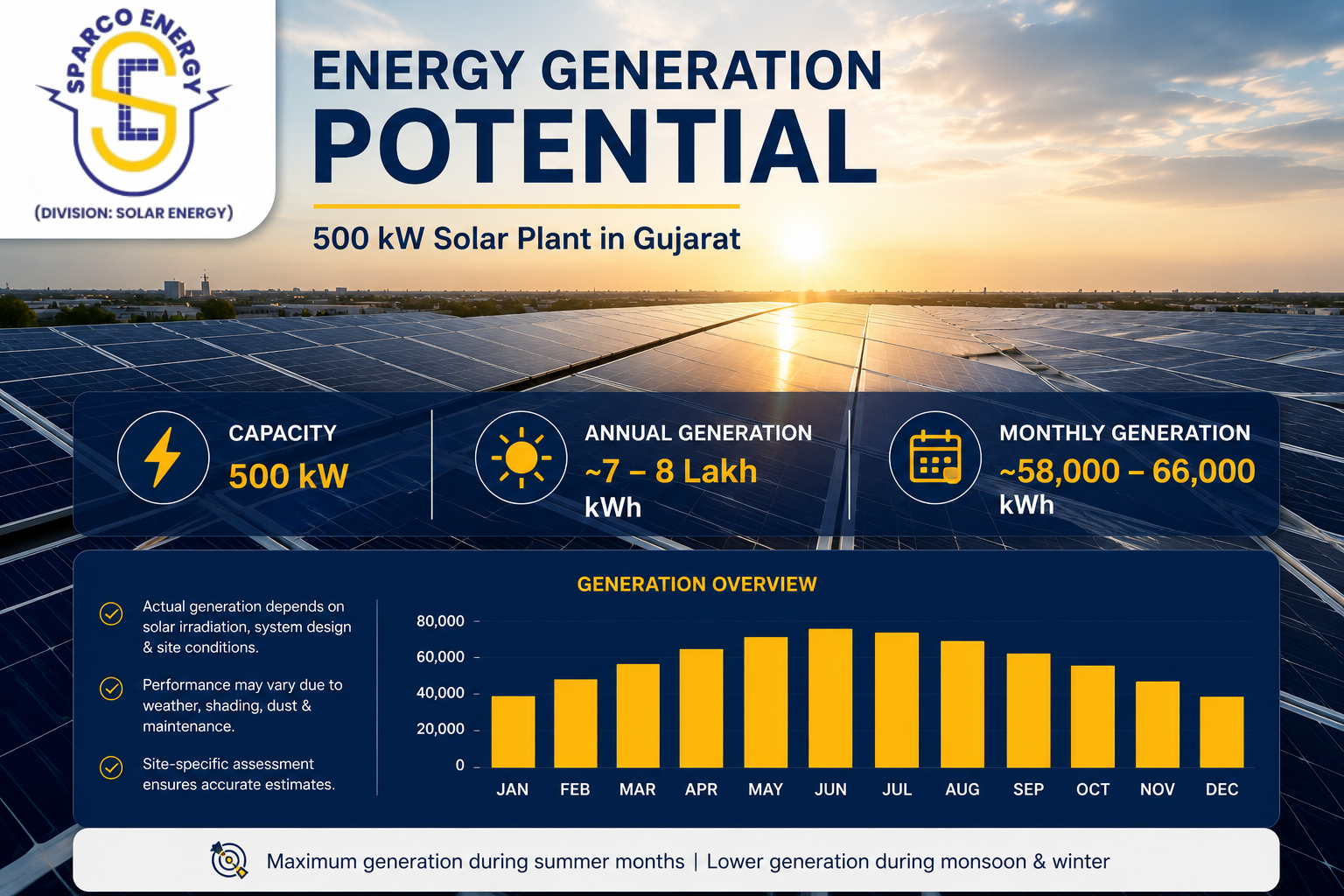
As an illustrative planning range, a 500 kW system operating at approximately 16–18% capacity utilisation would produce around 7.0–7.9 lakh kWh per year before considering the project’s specific performance assumptions.
For example:
- 500 kW × 8,760 hours × 16% = 700,800 kWh/year
At 18%:
- 500 kW × 8,760 hours × 18% = 788,400 kWh/year
This means an indicative annual generation range could be around 7–8 lakh units, but the actual estimate should be calculated using site-specific solar resource, system losses and design parameters.
Approximate Average Generation
| PARAMETER | ILLUSTRATIVE RANGE |
|---|---|
| Installed Capacity | 500 kW |
| Annual Generation | ~7–8 lakh kWh |
| Average Monthly Generation | ~58,000–66,000 kWh |
| Actual Generation | Site and design dependent |
A professional EPC feasibility study should provide a more accurate generation estimate before the project is finalised.
500 kW Solar Plant ROI and Payback Period
The ROI of a 500 kW solar plant cannot be accurately stated as one fixed percentage for every business.
The financial return depends on factors such as:
- Total project investment
- Electricity tariff
- Annual solar generation
- Percentage of solar power consumed on-site
- Applicable electricity charges
- Financing cost
- Operation and maintenance expenses
- System degradation
- Regulatory and commercial arrangements
Example of a Simple Solar Savings Calculation
Suppose a 500 kW solar plant generates approximately 750,000 units per year.
If a business can effectively offset electricity purchases at an assumed value of ₹8 per unit, the gross electricity-cost offset would be:
750,000 × ₹8 = ₹60 lakh per year
This is only an illustrative calculation, not a guaranteed saving. Actual savings depend on the business’s tariff structure, consumption profile, applicable charges, generation and project configuration.
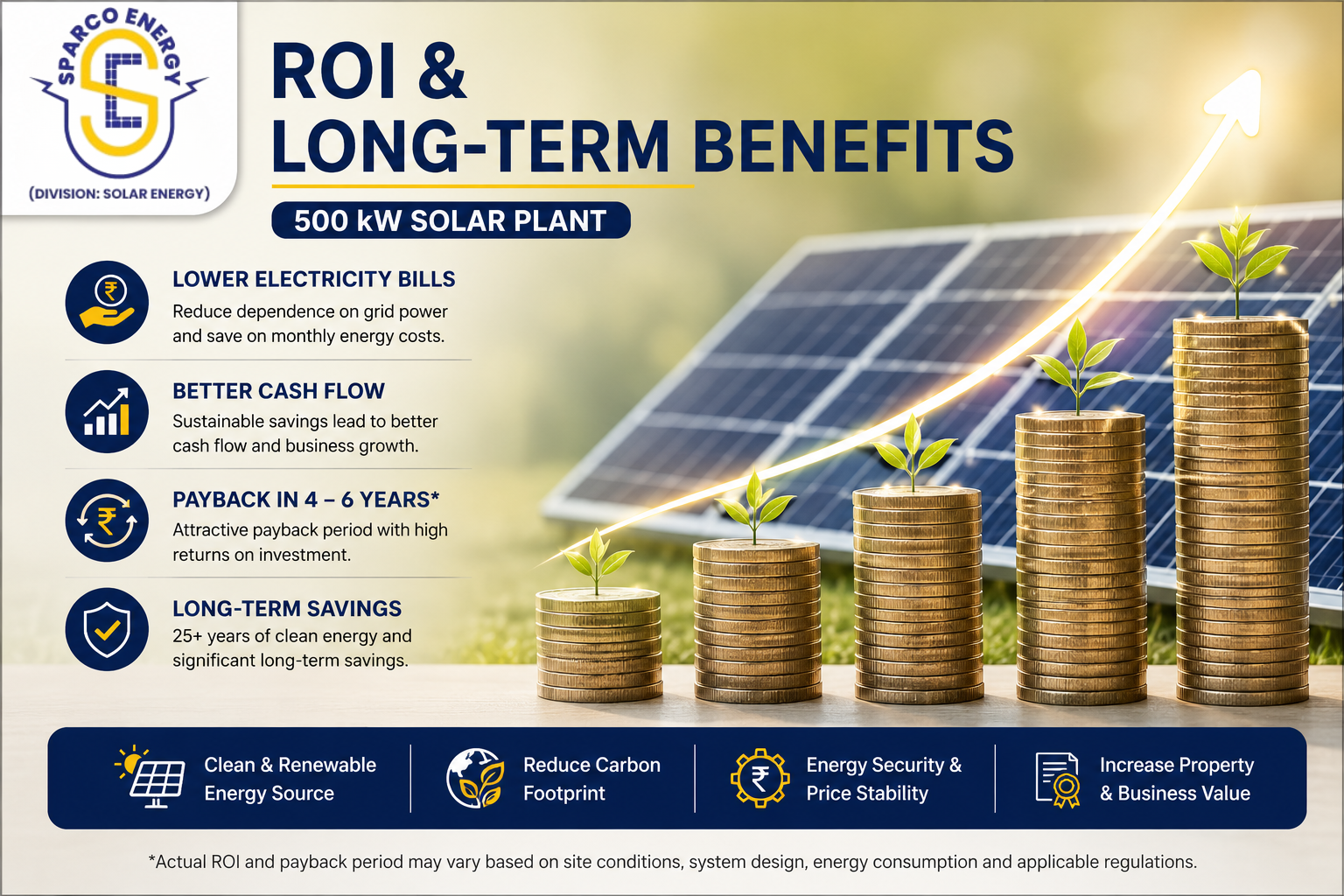
This is why a proper project-specific ROI model is more useful than simply quoting a standard 4–6 year payback or 15–20% ROI for every 500 kW installation.
How Much Roof Area Is Required for a 500 kW Rooftop Solar Plant?
The space requirement depends on the selected solar modules, module efficiency, mounting arrangement, roof orientation, maintenance pathways, shading and safety clearances.
A 500 kW rooftop solar project therefore cannot be designed solely by multiplying capacity by a fixed area figure.
During a site survey, an EPC company should evaluate:
- Available roof area
- Roof orientation
- Roof slope
- Structural strength
- Shading
- Existing equipment
- Maintenance access
- Fire and safety requirements
- Cable routing
- Space for electrical equipment
This assessment helps determine whether the available factory or commercial roof can accommodate the required system capacity.
500 kW Rooftop Solar Plant for Factories
For factories and manufacturing units, a 500 kW rooftop solar plant can be particularly useful when electricity consumption is high during daylight hours.
Key advantages can include:
Reduced Grid Electricity Dependence
- Solar generation can offset a portion of electricity purchased from the grid, depending on the facility’s consumption profile and applicable electricity arrangements.
Better Use of Existing Space
- Factory rooftops, warehouses and commercial buildings can provide valuable space for solar generation without requiring additional land.
Potential Long-Term Energy Savings
- Once installed, solar generation can help businesses manage electricity expenditure over the operating life of the system, subject to project performance and applicable tariffs.
On-Site Power Generation
- Generating electricity close to the point of consumption can reduce dependence on externally supplied electricity for the portion of energy covered by the solar system.
Sustainability Benefits
- Industrial solar projects can also contribute to a company’s renewable-energy and sustainability objectives.
Rooftop vs Ground-Mounted 500 kW Solar Plant
A 500 kW project does not necessarily have to be installed on a rooftop.
| FACTOR | ROOFTOP SOLAR | GROUND-MOUNTED SOLAR |
|---|---|---|
| Land Requirement | Lower | Requires suitable land |
| Existing Space | Uses building roof | Requires separate site |
| Roof Assessment | Required | Not applicable |
| Structural Assessment | Important | Site/civil assessment required |
| Maintenance Access | Depends on roof | Generally easier site access |
| Best Suited For | Factories, warehouses, commercial buildings | Sites with suitable land availability |
The right option depends on the facility, available space, electricity requirement and project economics.
What Affects the Cost of a 500 kW Solar Plant?
Before requesting a 500 kW solar EPC quote, businesses should understand the factors that can change the final project price.
1. Solar Module Selection
Module efficiency, technology, manufacturer and warranty specifications can influence both system design and investment.
2. Inverter Selection
The inverter configuration should match the system design and electrical requirements of the facility.
3. Mounting Structure
Rooftop and ground-mounted projects require different structural approaches.
4. Roof Condition
Older or structurally unsuitable roofs may require additional work before solar installation.
5. Electrical Infrastructure
Transformer capacity, LT/HT systems, cabling, protection equipment and interconnection requirements can affect project scope.
6. Site Conditions
Accessibility, shading, dust, roof layout and installation complexity can influence engineering and installation requirements.
7. Project Configuration
A project designed for self-consumption may have different requirements from a project involving captive or other commercial power arrangements.
What Is Included in a 500 kW Solar EPC Project?
A professional 500 kW Solar EPC Company in Gujarat should be able to manage the major stages of the project rather than simply supplying solar panels.
Depending on the project scope, EPC services may include:
- Site assessment
- Energy-consumption analysis
- Technical feasibility
- Solar system design
- Equipment selection and procurement
- Structural and electrical engineering
- Installation
- Testing and commissioning
- Grid-related coordination
- Monitoring setup
- Documentation
- Operation and maintenance support
A clearly defined EPC scope helps businesses understand what is included in their project quotation.
How to Choose a 500 kW Solar EPC Company in Gujarat
Choosing the right EPC partner is just as important as choosing the right equipment.
Before finalising a 500 kW solar installation company in Gujarat, businesses should evaluate:
- Experience with industrial and commercial projects
- Previous project portfolio
- Engineering and feasibility capabilities
- Quality of modules and inverters
- Installation standards
- Electrical and grid-connection expertise
- Project management capabilities
- Warranty and after-sales support
- Monitoring and O&M services
- Transparency of the quotation
A good EPC partner should be able to explain why a particular system design is recommended, rather than simply providing a price per kW.
Challenges to Consider Before Installing a 500 kW Solar Plant
A 500 kW solar project requires proper planning before installation begins.
Site and Structural Assessment
For rooftop systems, the existing structure must be evaluated to ensure it is suitable for the proposed installation.
Grid Connectivity
The required electrical and grid-interconnection arrangements depend on the project’s configuration and applicable regulations.
Regulatory Requirements
Applicable approvals, metering arrangements and commercial mechanisms can vary depending on the type of project and prevailing regulations.
Operation and Maintenance
Dust, soiling, equipment faults and environmental conditions can affect generation. Regular monitoring and maintenance help maintain system performance.
Accurate Financial Planning
Businesses should calculate ROI using their actual electricity consumption, tariff, expected generation, project investment and applicable charges instead of relying on generic online payback figures.
Why Gujarat Is a Strong Market for Solar Projects
Gujarat has significant solar potential and a large base of industrial and commercial electricity consumers.
Cities and industrial regions such as Ahmedabad, Vadodara, Rajkot, Surat and other parts of Gujarat have substantial manufacturing, commercial and industrial activity, creating opportunities for businesses to evaluate on-site renewable power generation.
However, the suitability and financial performance of an individual 500 kW solar project should always be assessed using the specific site’s solar resource, electricity consumption, available space, system design and applicable regulations.
Why Choose Sparco Energy for Industrial & Commercial Solar?
For a business evaluating a 500 kW industrial solar plant in Gujarat, the EPC partner should understand both the technical and commercial side of the project.
Sparco Energy provides solar EPC solutions for industrial and commercial applications, helping businesses evaluate their solar requirements and develop project-specific solutions.
The focus should be on:
- Site and energy assessment
- Project feasibility
- System engineering and design
- Solar equipment procurement
- Installation and commissioning
- Project monitoring
- After-sales support
Sparco Energy’s existing industrial and commercial project portfolio can also help prospective customers evaluate the company’s experience with business-oriented solar installations.
Planning a 500 kW Solar Plant in Gujarat?
The right 500 kW solar system starts with understanding your electricity consumption, available space, expected generation and project economics.
Instead of relying on a generic online cost estimate, get a project-specific assessment for your facility.
Get Your 500 kW Solar Project Assessment
Sparco Energy can help evaluate:
- Site suitability
- Recommended system capacity
- Expected solar generation
- Estimated investment
- Potential electricity savings
- ROI and payback assumptions
- EPC requirements
Frequently Asked Questions
1 What is the cost of a 500 kW solar plant in Gujarat?
There is no single fixed price for a 500 kW solar plant. The final cost depends on equipment selection, mounting structure, site conditions, electrical infrastructure, installation requirements, grid connectivity and overall project scope. A site-specific assessment is recommended for an accurate quotation.
2 How much electricity does a 500 kW solar plant generate?
As an illustrative planning range, a 500 kW system may generate approximately 7–8 lakh kWh per year, depending on solar irradiation, system design, losses, equipment performance and operating conditions.
3 What is the ROI of a 500 kW solar plant?
ROI varies from project to project. Electricity tariff, annual generation, project investment, self-consumption, financing and applicable charges all affect the financial return. A project-specific financial model provides a more reliable ROI estimate.
4 How much roof area is required for a 500 kW rooftop solar plant?
The required area depends on module efficiency, panel dimensions, mounting configuration, shading, roof layout, access pathways and safety clearances. An EPC site survey is required to determine the practical rooftop capacity.
5 Is a 500 kW solar plant suitable for factories?
Yes, a 500 kW solar plant can be suitable for factories and manufacturing facilities with substantial electricity consumption. The appropriate capacity should be determined from the facility's electricity bills, load profile, available roof/land and technical feasibility.
6 What factors affect the price of a 500 kW solar plant?
Major factors include solar modules, inverters, mounting structure, electrical infrastructure, roof or land conditions, civil work, installation complexity, grid connectivity and the overall EPC scope.
7 How do I choose a 500 kW solar EPC company in Gujarat?
Look for an EPC company with relevant industrial project experience, strong engineering capabilities, quality equipment, transparent quotations, installation expertise and reliable after-sales support.
8 Can I get an exact 500 kW solar plant quotation online?
An online estimate can provide only a preliminary indication. An accurate quotation normally requires information about the site, electricity consumption, roof/land availability, electrical infrastructure, system design and project requirements.